
Most commercial submissions arrive with a broker note, a loss run, and a half-completed ACORD. The underwriter who can answer five specific questions before opening any of them moves first — and right. The rest of the desk plays catch-up for the next forty minutes.
This is the order we run, every time, on every account. It hasn't changed in three years, even as the tools around it have.
1. Who is this company, really?
Names lie. EINs don't. Before anything else, we resolve the legal entity behind the submission — parent, doing-business-as, related entities sharing a tax ID. About 18% of mid-market submissions name a marketing entity that isn't the named insured on the policy. That's a binding problem waiting to happen.
The fastest path:
- Match the named insured to a Secretary of State filing in the operating state.
- Pull the EIN; cross-check it against any related corporate filings.
- Flag any aliases, DBAs, or holding entities for the snapshot summary.
2. What does the business actually do?
NAICS codes are right about 73% of the time on first-year submissions and decay sharply at renewal as businesses pivot, expand, or absorb subsidiaries. The code on the submission is a starting point — not a verdict.
“The single highest-leverage thing an underwriter can do in the first minute of a submission is reclassify the business — not re-rate it.”
Jordan Kim · Underwriting Strategy
We pull three signals to validate classification: the company's own description on its website, the licenses it holds with state regulators, and recent press or job postings describing operations. If two of three disagree with the submitted NAICS, the snapshot reclassifies before pricing runs.
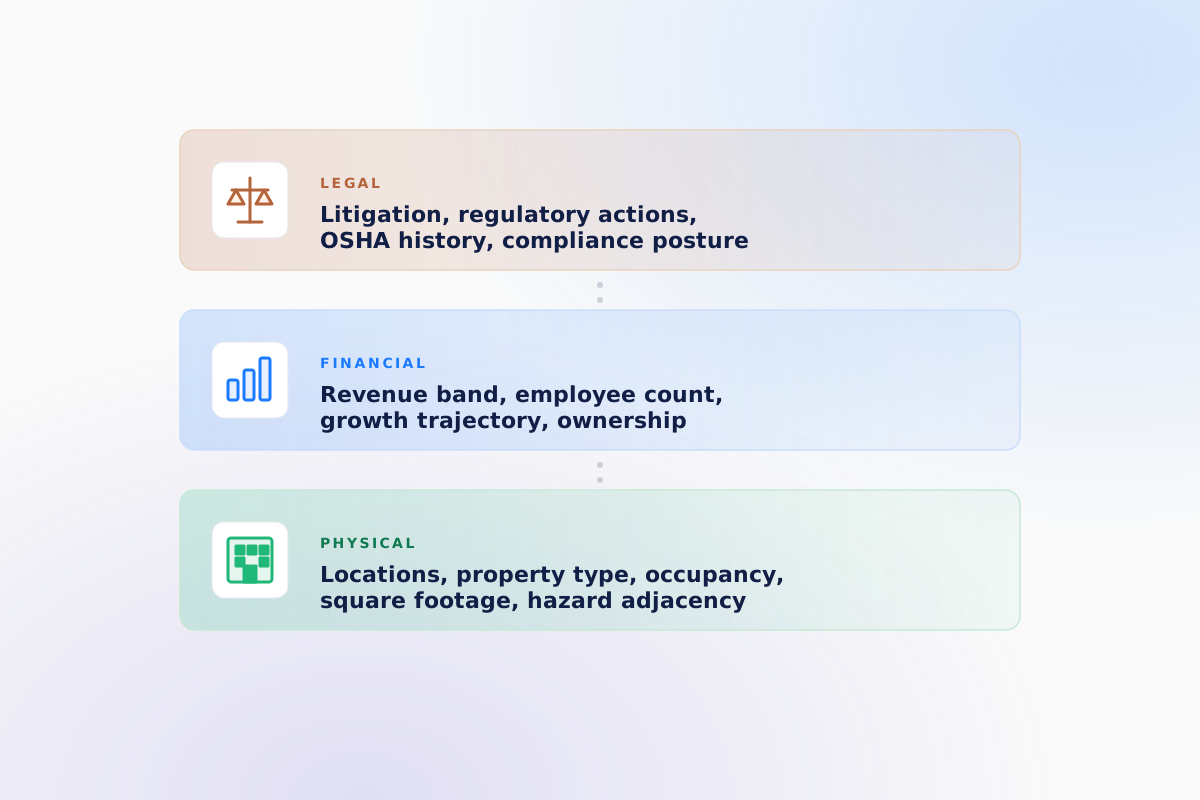
3. Where are they exposed — physically, financially, legally?
This is the question most submissions answer last. We answer it third, because it shapes how the next two questions are interpreted.
- Physical: location footprint, property type, occupancy, square footage, hazard adjacency.
- Financial: revenue band, employee count, growth trajectory, ownership stability.
- Legal: open litigation, regulatory actions, OSHA history, compliance posture.
4. What has changed since the last cycle?
For renewals, this is the whole game. New submissions get a baseline. Renewals get a differential — what the snapshot found this year that wasn't true last year. Premium leak almost always lives in the delta.
5. What can we defend, and what can't we?
Every finding the snapshot surfaces needs a source — a primary record, a regulator filing, a verified citation. Anything that can't trace back gets labeled as a gap, not a fact. The defensibility score moves separately from the confidence score, and underwriters who understand the difference price tighter and defend faster.
None of these questions are new. What's changed is how fast a research stack can answer them — and whether every answer comes with the receipts.
If your team is still piecing the picture together one tab at a time, that's the gap Relativity6 closes. Book a demo and we'll run a snapshot on a real account from your book.